
Google LSA vs Google Ads: Which One Actually Makes You Money
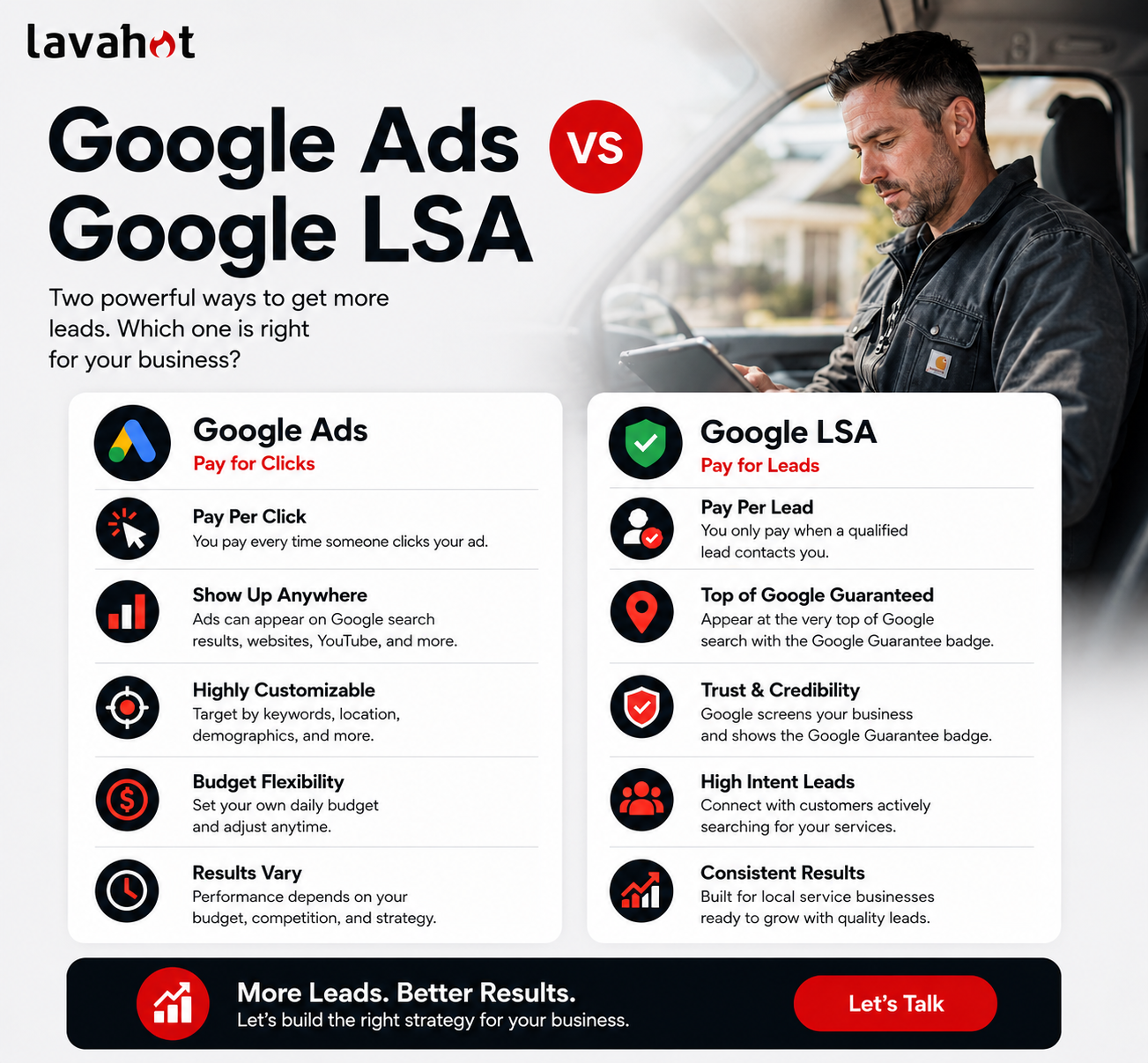
If you've ever tried to figure out whether to run Google Local Service Ads or Google Ads, you've probably gotten one of two answers.
Either someone told you LSA is the future and you should drop everything else. Or someone told you Google Ads gives you more control and LSA is too limited.
Both answers are incomplete.
The truth is they're not competitors. They're different tools built for different jobs. And if you're running one without understanding what the other does — you're leaving money on the table.
Here's the full breakdown.
What is Google LSA?
Google Local Service Ads are the listings that appear at the very top of Google search results — above everything else, including regular Google Ads. They show your business name, your rating, your review count, and a click-to-call button.
You don't pay per click. You pay per lead.
LSA is built around trust signals. The Google Guaranteed or Google Screened badge tells the searcher that Google has verified your business — license, insurance, background checks depending on your industry. That badge does a lot of selling before a word is spoken.
The algorithm that determines who shows up in LSA is driven primarily by three things: your review count, your review rating, and your responsiveness to leads. The businesses that respond fastest and have the most reviews win the most impressions.
What are Google Ads?
Google Ads — formerly Google AdWords — are the text-based paid search listings that appear below LSA and above organic results. You bid on specific keywords and pay every time someone clicks your ad.
Unlike LSA, Google Ads gives you precise control. You choose exactly which search terms trigger your ad, what geography you target, what time of day your ads run, what device they show on, and what landing page the click goes to.
The tradeoff is complexity. Google Ads rewards expertise. A poorly managed campaign burns budget fast. A well-managed campaign can be one of the highest-ROI marketing investments a business can make.
The Core Difference
LSA sells trust at the top of the page. Google Ads sells intent at the keyword level.
LSA says: "This business is verified and highly rated — call them." Google Ads says: "This business showed up when you searched for exactly what you need."
One converts on credibility. The other converts on relevance.
When LSA Wins
LSA is the stronger play when:
- You have strong reviews. LSA is essentially a review competition. If you have 80 reviews at 4.8 stars and your competitor has 12 at 4.2, you will win more impressions at a lower cost per lead. Your reputation does the heavy lifting.
- You want simple, predictable lead costs. LSA removes most of the complexity of paid search. You set a weekly budget, Google manages the delivery, you pay per lead. For businesses that don't have the bandwidth to manage a sophisticated ad account, LSA is a cleaner entry point.
- You're in a high-intent service category. LSA performs best in categories where the searcher has immediate need — plumbing, HVAC, electrical, legal services, financial advising. The closer your service is to an emergency or urgent need, the stronger LSA performs.
- You want top-of-page placement without a big budget. LSA sits above Google Ads in the search results. That real estate used to require significant ad spend to compete for. LSA levels that playing field.
When Google Ads Wins
Google Ads is the stronger play when:
- You want to control the message. LSA gives you limited creative control. Google Ads lets you write your own headlines, test different angles, and speak directly to the specific search term someone used. If someone searches "emergency roof repair after storm" you can show them an ad written specifically for that situation.
- You want to target specific services or locations precisely. LSA targets broadly within a geography. Google Ads lets you isolate campaigns by service type, neighborhood, zip code, or even radius around a specific address. For businesses with multiple service lines or locations, that precision matters.
- You're running a promotion or time-sensitive offer. LSA has no mechanism for promoting a specific offer. Google Ads lets you build campaigns around seasonal promotions, limited-time pricing, or specific events with messaging tailored to drive urgency.
- You want to scale aggressively. LSA budgets are capped by Google's lead volume in your area. Google Ads has no ceiling — if the demand exists and your campaigns are profitable, you can scale spend indefinitely.
The Real Answer: Run Both
The businesses that win on Google search are running LSA and Google Ads simultaneously — but with a clear understanding of what each one is doing.
LSA captures the high-intent, trust-driven clicks at the top of the page. Google Ads captures the keyword-specific, offer-driven clicks in the middle. Together they dominate the page.
The key is not splitting your budget equally. It's understanding your current position:
- If your reviews are strong, weight toward LSA first. Let your reputation generate leads at a low cost per lead while your Google Ads campaigns build and optimize.
- If your reviews are thin, lean into Google Ads while you actively build your review count. A strong Google Ads campaign with a weak LSA profile is still profitable. A strong LSA profile with no Google Ads leaves keyword-level intent uncaptured.
The System Behind Both
Here's what most businesses miss entirely.
It doesn't matter whether you're running LSA, Google Ads, or both — if the system behind the ads is broken, the leads don't become revenue.
The businesses that get the best ROI from Google advertising aren't just running better ads. They're running better follow-up. Every lead that comes in gets contacted within five minutes. Every missed call gets an automatic text back. Every prospect gets nurtured through a pipeline until they book or say no.
The ad gets the lead in the door. The system converts it.
If you fix the system first — CRM, automation, speed to lead — then every dollar you spend on LSA or Google Ads works harder than it did before.
Bottom Line
Google LSA and Google Ads are not an either/or decision. They're a sequencing decision.
Start with whichever matches your current strengths. Build reviews aggressively if you're going LSA-first. Build campaign structure carefully if you're going Google Ads-first. And run both as soon as your budget allows.
But before you do either — make sure the system that catches those leads is built and running. Because the best ad in the world can't save a business that doesn't follow up.
Want to know exactly where your lead system is leaking revenue?
Take the free Contractor Growth Scorecard and get a personalized gap analysis in under 5 minutes.
Take The Scorecard